-
07 September 2026 - 09 September 2026
-
9:00 am - 5:00 pm
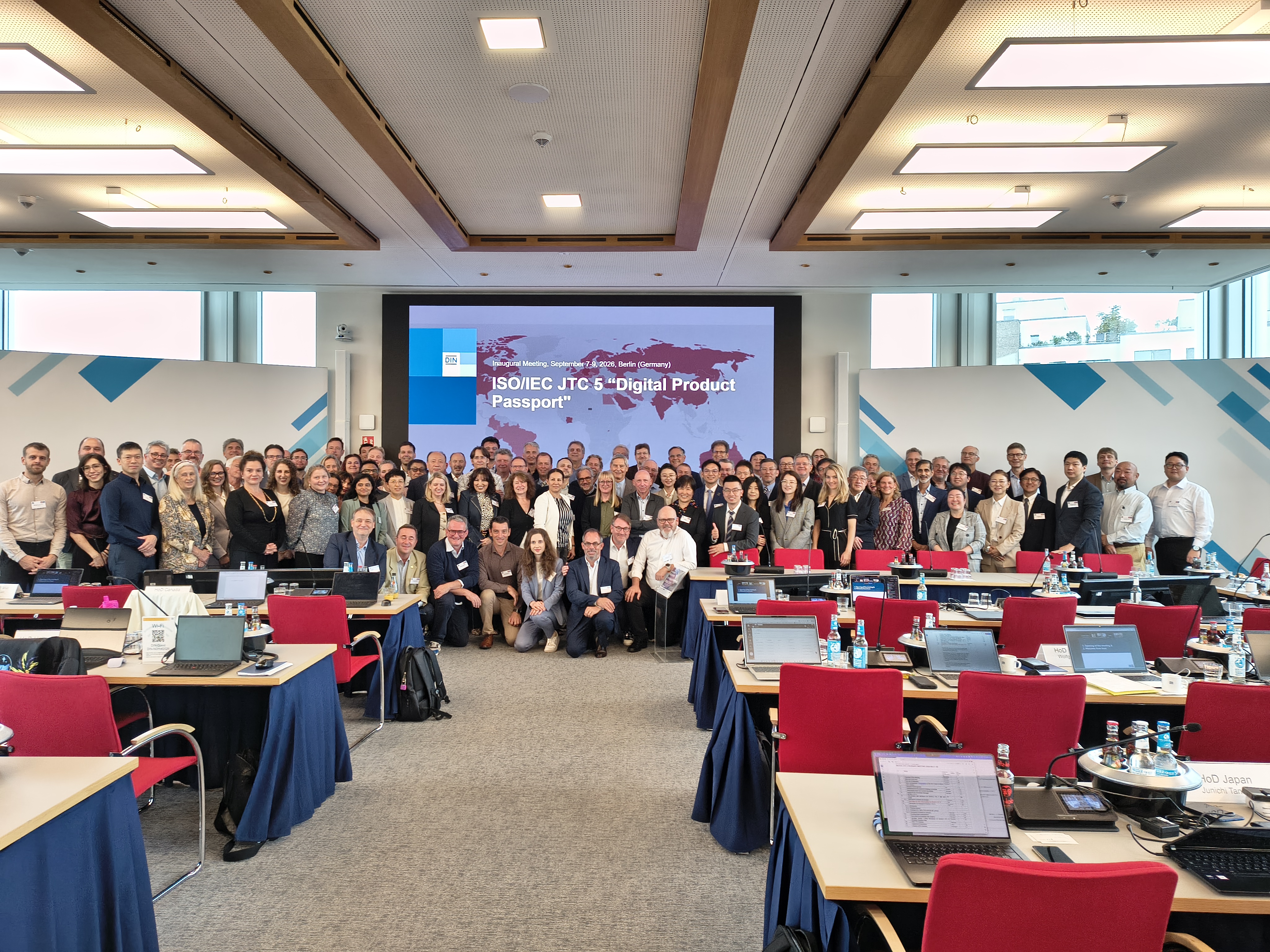
ISO/IEC JTC 5 Digital Product Passport Inaugural Plenary Meeting- September 2026
From September 7th to 9th, 2026, DIN Deutsches Institut für Normung e.V., a national standardisation body in Germany, hosted the ISO/IEC JTC 5 Digital Product Passport Inaugural Plenary Meeting in Berlin and online. Given the strong strategic positioning of digital product passport topics within the European Commission's yearly Rolling Plan for ICT standardisation and in global digital standardisation, the StandICT.eu Programme supported the meeting financially.
A Milestone for Formal Establishment of ISO/IEC JTC5
The meeting formally established JTC 5, adopted its terms of reference, and agreed the first work items, along with the group’s strategic business plan, liaisons and work structure. This multi-stakeholder gathering enabled coordination of international positions across Member States, industry, SMEs and academia. This directly supports the Rolling Plan’s priorities by creating a global standards home for implementing EU legislation (ESPR, Data Act, AI Act, NIS2, etc.).
Furthermore, the participants agreed on the collaboration and liaison mechanisms, especially with the European Standardisation Organisations (CEN/CENELEC, ETSI), and relevant EU structures and projects, ensuring transparency, openness and balanced participation. This responds directly to the Multi‑Stakeholder Platform guidelines and its principles on inclusive, consensus‑based ICT standardisation.
The first concrete steps towards a globally aligned framework for Digital Product Passport standardisation
These three full meeting days resulted in formal resolutions covering the committee title and scope, focusing on Digital Product Passport (DPP) deployment, interoperability, and product-related information flow, while excluding sector-specific standards. The committee also established the Chair Advisory Group and Working Group (WG) 1, “Foundations, and specified the creation of internal liaisons with relevant ISO and IEC committees. Regarding initiated standardisation projects, the committee agreed to divide ISO 25534-1 (Digital product passport) into two parts: “Concepts and Terminology” and “Overview and Fundamental Principles”. For the next plenary meeting in February/March 2027, the group announced a call for expressions of interest to host, with formal announcement expected in October 2026.
In this sense, the meeting group agreed on the follow-up activities through the resolutions. Nominations for the WG 1 Convenor and the Project Leaders of ISO/IEC 25534-1 and ISO/IEC 25534-2 are to be submitted to the JTC 5 Secretariat by 8 October 2026.
WG 1 “Foundations” will continue the technical work on concepts, terminology, overview and fundamental principles, including revision of the scope of Part 2. The Chair Advisory Group will support strategy, coordination, portfolio coherence and the Strategic Business Plan. In addition, the proposed Committee Collaboration Advisory Group and the Vice-Chair position will be further discussed at the next Chair Advisory Group meeting and the next plenary meeting, respectively.
Practical engagement channels for technical experts and delegates
The meeting brought together a broad international community of national delegations, liaison organisations, and technical experts, with both on-site and remote participation from over 30 countries. Participants included members of national delegations, liaison candidates, and established international standardisation actors. SMEs and stakeholder organisations were addressed in particular through liaison participation, including Small Business Standards (SBS) and ANEC.
Around 110 participants attended on site, with approximately another 110 joining online, and the gender balance reflected a 30% participation rate for female members. The liaison agenda item supported practical engagement: organisations gave short introductions and then met directly with JTC 5 members in dedicated exchange areas. This format helped new participants understand JTC 5's work, identify possible contribution channels, and connect with national bodies and technical experts. The hybrid format further lowered participation barriers for experts who could not travel to Berlin.
Acknowlegements
DIN hosted this plenary, which also serves as the Secretariat of ISO/IEC JTC 5. Dr Adrian von Mühlenen, ISO/IEC JTC 5 Chair, and Amelie Buss, Committee Manager, oversaw the meeting organisation. StandICT.eu Programme, supported by the European Commission, co-founded this event.
Read more
https://www.iso.org/committee/11760382.htm
https://www.linkedin.com/posts/jtc-5-plenary-ugcPost-7505884151661629440-nCRy/?rcm=ACoAACft02gBYqqOr56CdRh88yesGtuPyZOwQGE l